Blog
Maple Avenue colonials, Wolf Trap oaks, and why finished basements sweat at the trunks
Vienna's 1950s–70s colonials store spring pollen inside the coolest metal in the house — the basement supply trunks. Discover how the Wolf Trap canopy, finished basements, and summer condensation create a self-reinforcing dust-moisture cycle.

The condensation cycle that makes pollen stick permanently
A supply trunk carrying 55-degree air through a basement where ambient temperature is 68 degrees develops surface condensation whenever relative humidity exceeds about 60 percent. In Vienna, indoor summer RH routinely climbs past that threshold during any week without active dehumidification. The thin moisture layer on the trunk exterior is invisible — but pollen grains that contact it adhere on impact and stay.
Over successive pollen seasons, this creates a laminated coating. Each spring's oak and maple load bonds to last year's layer. The coating is not loose dust that vibrates free. It is a composite of biological material and mineral moisture residue that hardens slightly between seasons. By the time it is thick enough to smell, it has been building for years.
How 1950s–70s colonial floor plans concentrate the problem
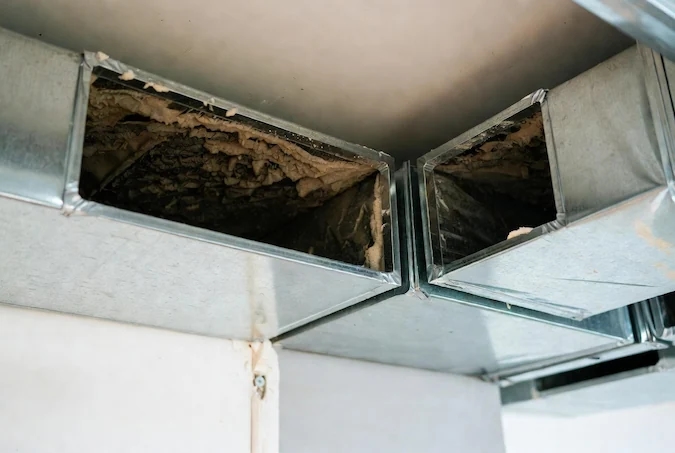
Vienna colonials of this era share a common HVAC layout: the air handler sits in the basement, supply trunks run through the floor joists above it, and branch ducts rise through interior walls to registers on the first and second floors. The longest runs serve the upstairs bedrooms. Those runs travel through the coolest part of the basement ceiling before entering heated wall cavities. That transition zone — cold trunk meeting warm wall — is where condensation is heaviest and dust accumulation fastest.
A later rec-room addition typically taps into the trunk with a branch splice. Splices from the 1980s and 1990s were often sealed with cloth tape that has since dried and separated. Each gap draws unconditioned basement air into the supply stream, adding moisture and whatever particles the basement air carries.
Our Special Offers
Transparent flat-rate pricing. No counting vents. No surprise add-ons.
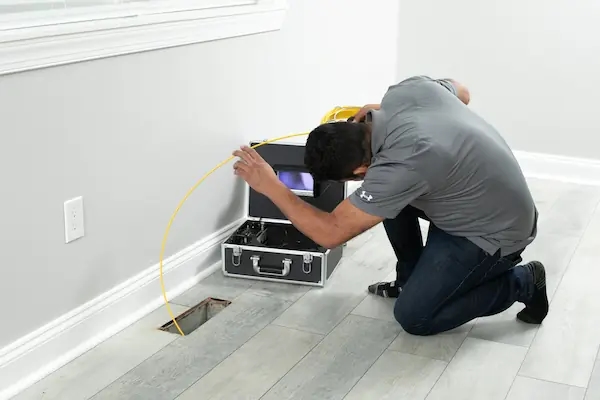
Dryer Vent Cleaning
$199
Professional dryer vent cleaning with rotary brush and high-powered vacuum to reduce fire risk and improve dryer efficiency.
Learn more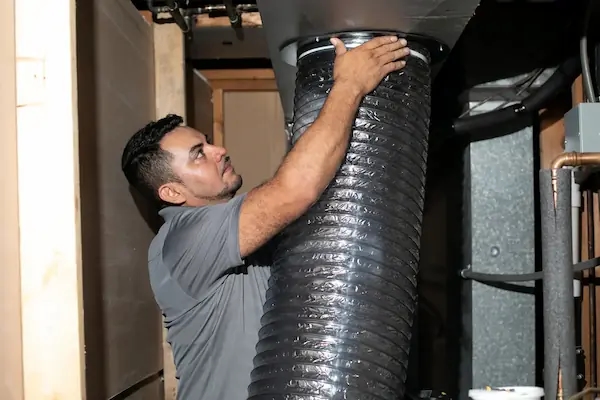
Air Duct Cleaning & Sanitization
$299
Professional cleaning of one complete air duct system with complimentary sanitization upon request and before/after photo proof.
Learn more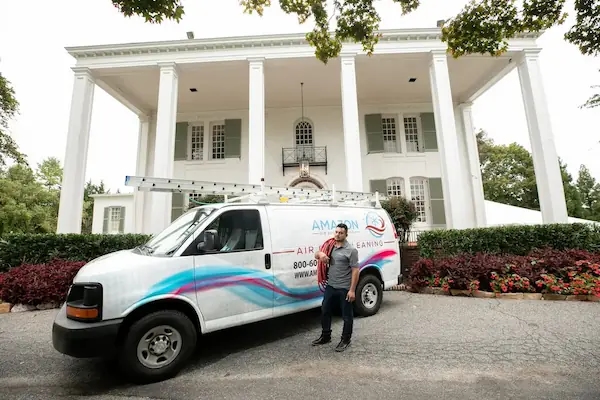
Air Duct Cleaning, Dryer Vent Cleaning & Sanitization
$399
Complete air duct system cleaning plus dryer vent cleaning and sanitization — our most popular package.
Learn moreWolf Trap's canopy is beautiful — and measurably heavy
The mature oak and maple canopy stretching from Wolf Trap National Park through the residential streets along Courthouse Road and toward Glyndon Park produces one of the densest pollen loads in Fairfax County each April and May. A car parked on Nutley Street overnight collects a visible yellow film by morning. That same pollen reaches every return grille at ground level.
Unlike road dust, which is largely mineral and inert, tree pollen is organic. Once it contacts moisture inside a cool trunk, it can support microbial growth under the right conditions. This is the origin of the musty smell that Vienna homeowners report on the first AC startup after a spring rain — the trunk interior briefly warms, moisture re-activates biological material in the coating, and the blower pushes that air upstairs before the system reaches steady-state temperature.
Signals that go beyond normal seasonal dust
Vienna homes under the canopy will always collect more pollen than homes on open lots. These patterns indicate the trunks themselves need attention, not just the filters:
- A yellow-gray tint visible when you pull a supply register and look into the trunk opening — the color comes from layered pollen on the metal walls.
- Musty startup smell that appears only after the system has been off for 12 or more hours, then dissipates within 20 minutes of continuous operation.
- Allergy symptoms that improve noticeably when you leave the house, even during high outdoor pollen days — suggesting indoor recirculated pollen concentration exceeds outdoor levels.
- A second-floor bedroom register that produces visible dust puffs when the blower kicks on after a rain delay.
Breaking the cycle without over-spending
The condensation-pollen cycle cannot be eliminated entirely in a canopy-heavy area, but it can be slowed significantly between professional cleanings. For Vienna-specific scheduling and pricing, see the Vienna location page. If the rec-room splice or a second-floor laundry run is part of the issue, bundling dryer vent cleaning covers both in one visit.
- Set a basement dehumidifier to hold RH at or below 48 percent from May through September — this keeps trunk surfaces dry enough to prevent new pollen adhesion.
- Replace filters at the start and midpoint of pollen season rather than on a fixed 90-day calendar.
- Seal visible gaps at trunk-to-branch splices with mastic or foil tape — cloth tape from the 1990s has almost certainly failed.
- Keep basement window wells clear of leaf litter so they do not channel moisture toward foundation walls near the air handler.
Frequently Asked Questions
When should Vienna homeowners consider duct cleaning?
When musty startup smells return each humid week, or cool Vienna trunks keep turning dust into a sticky film.
Where do I book air duct cleaning for Vienna?
Open the Vienna service page for flat-rate packages and local dispatch, or call (800) 606-3334 for Vienna.
Can Vienna duct and dryer vent cleaning happen the same day?
Yes — book ducts, dryer vents, or both in one visit for Vienna from the Burke crew.
Does a dehumidifier replace duct cleaning in Vienna?
Lower humidity helps Vienna basements, but it does not remove debris already sitting in trunks. Cleaning and moisture control work together.
Where we schedule from
For booking, use your city page or call our Burke and Bethesda offices. See all cities we serve.
Our offices
Contact Us
Our specialists will contact you immediately. (800) 606-3334 · support@amazonadc.com