Blog
Montgomery County humidity, cool basement trunks, and why registers get dusty again
Rockville spans 1950s Twinbrook ranches to King Farm townhomes — all sitting on humid Piedmont soil. Learn how basement-origin condensation drives duct contamination across housing eras.

Piedmont clay and what it means for basement humidity
Rockville sits on the Maryland Piedmont — a geological zone of dense clay soils that hold water rather than drain it. After a heavy rain, the ground around a Twinbrook ranch or Hungerford colonial saturates and stays wet for days. That moisture migrates through foundation walls by capillary action, raising the relative humidity in the basement even when no visible water is present.
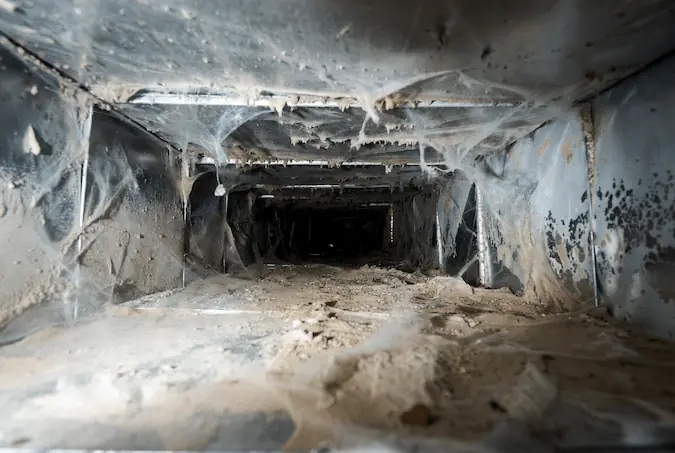
An air handler sitting in this environment processes air that is consistently more humid than the outdoor ambient reading might suggest. The basement is cooler than the outside air but wetter than the upper floors. When the system runs, it pushes that moisture into trunk lines that chill further as they extend away from the blower. The temperature differential sets up the condensation cycle that turns dry dust into bonded film.
I-270 corridor dust and the compound load on Rockville returns
The I-270 technology corridor runs directly through Rockville, carrying commuter traffic, commercial vehicles, and the dust generated by ongoing development along its frontage. Homes in Twinbrook, College Gardens, and the neighborhoods flanking Rockville Pike sit within the drift zone where fine particulates — brake dust, tire wear, road surface abrasion — settle on outdoor surfaces and enter homes through every building-envelope gap.
These traffic-origin particles combine with the organic debris that every Mid-Atlantic suburb generates: tree pollen, grass seed, leaf fragments, and insect residue. The dual load means Rockville duct systems accumulate a mix of mineral and organic material that is chemically diverse. The mineral fraction bonds more aggressively to moist metal than organic material alone, which is why Rockville trunks can develop a noticeably gritty film that resists even high-velocity airflow.
Our Special Offers
Transparent flat-rate pricing. No counting vents. No surprise add-ons.
Dryer Vent Cleaning
$199
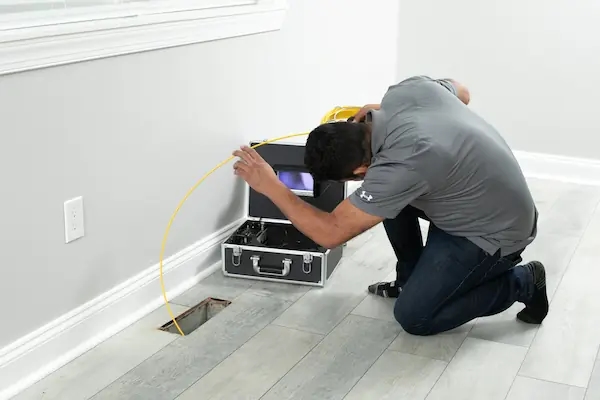
Professional dryer vent cleaning with rotary brush and high-powered vacuum to reduce fire risk and improve dryer efficiency.
Learn more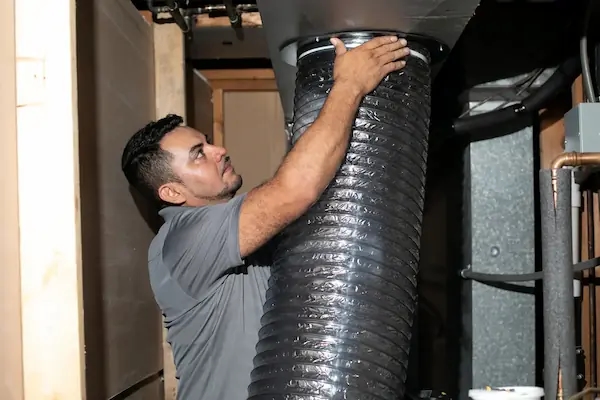
Air Duct Cleaning & Sanitization
$299
Professional cleaning of one complete air duct system with complimentary sanitization upon request and before/after photo proof.
Learn more
Air Duct Cleaning, Dryer Vent Cleaning & Sanitization
$399
Complete air duct system cleaning plus dryer vent cleaning and sanitization — our most popular package.
Learn moreHow Rockville's housing eras create different failure timelines
A 1955 Twinbrook ranch has had nearly seventy years of condensation cycles and filter-bypass events. The duct system in that home may have the original galvanized trunks with taped seams that have loosened over decades, allowing basement air to enter the supply stream at multiple points. The contamination is deep, layered, and well-bonded.
A 2005 King Farm townhome has a newer duct system with better sealing, but its compact mechanical closet and short trunk runs create a different vulnerability: any contamination that enters the system reaches the registers quickly because there is less trunk footage to absorb and distribute it. King Farm residents notice dust on registers sooner, which is actually an advantage — it prompts investigation before the buildup becomes severe.
What Rockville homeowners report across housing types
Despite the architectural variety, the symptoms converge around the same themes because the underlying cause — basement humidity meeting cool ductwork — is shared:
- A musty or damp odor from supply registers that appears when the system starts after a pause (overnight, after work, after vacation) and fades during continuous operation.
- A gritty gray film on register faces that feels rough to the touch rather than powdery, reflecting the mineral component from corridor traffic.
- A dehumidifier in the basement that fills its reservoir daily during summer, suggesting the ambient humidity in the mechanical space remains high despite best efforts.
Breaking the condensation-deposit cycle
Professional duct cleaning removes the accumulated material from trunk walls, branches, and register boots. Following the cleaning with aggressive basement dehumidification — targeting indoor relative humidity below fifty percent — slows the condensation that causes the cycle to restart. For older Twinbrook-era systems, sealing accessible duct joints during the cleaning visit reduces the infiltration of unconditioned basement air that contributes both moisture and additional particles.
Scheduling and flat-rate options for all Rockville neighborhoods are on the Rockville, MD service page. Twinbrook and Town Center townhome residents should pair duct cleaning with dryer vent cleaning — compact laundry closets in these homes produce the same moisture-feedback loop that drives duct contamination in the adjacent trunk lines.
Frequently Asked Questions
When should Rockville homeowners consider duct cleaning?
When musty startup smells return each humid week, or cool Rockville trunks keep turning dust into a sticky film.
Where do I book air duct cleaning for Rockville?
Open the Rockville service page for flat-rate packages and local dispatch, or call (800) 606-3334 for Rockville.
Can Rockville duct and dryer vent cleaning happen the same day?
Yes — book ducts, dryer vents, or both in one visit for Rockville from the Bethesda crew.
Does a dehumidifier replace duct cleaning in Rockville?
Lower humidity helps Rockville basements, but it does not remove debris already sitting in trunks. Cleaning and moisture control work together.
Where we schedule from
For booking, use your city page or call our Burke and Bethesda offices. See all cities we serve.
Our offices
Contact Us
Our specialists will contact you immediately. (800) 606-3334 · support@amazonadc.com