Blog
How corridor traffic particles and stacked laundry risers interact with village-style HVAC layouts
Reston's planned-community density puts dozens of HVAC systems in the same Dulles-corridor dust envelope. Learn why village layouts, stacked laundry risers, and shared parking garages create indoor-air patterns unique to this part of Fairfax County.

When fifty townhomes share the same wind pattern
Planned communities like Reston cluster buildings around courts and paths. The layout looks open. Aerodynamically it funnels Dulles-corridor air between buildings, concentrating brake-dust particulate at the ground level where most HVAC returns sit. A detached colonial on a half-acre lot pulls air from all sides; a Lake Anne courtyard unit pulls primarily from the gap between its building and the next one. That gap acts as a channel for the Toll Road film that coats every car on Reston Parkway.
South Lakes, North Point, and Hunters Woods villages each have a slightly different building orientation, but all of them position returns within a few feet of shared walkways and parking courts. During rush hour those courts carry a measurable spike in fine particulate. By the time you walk inside and forget about it, the return grille has already logged the commute.
Stacked laundry risers work like a slow chimney
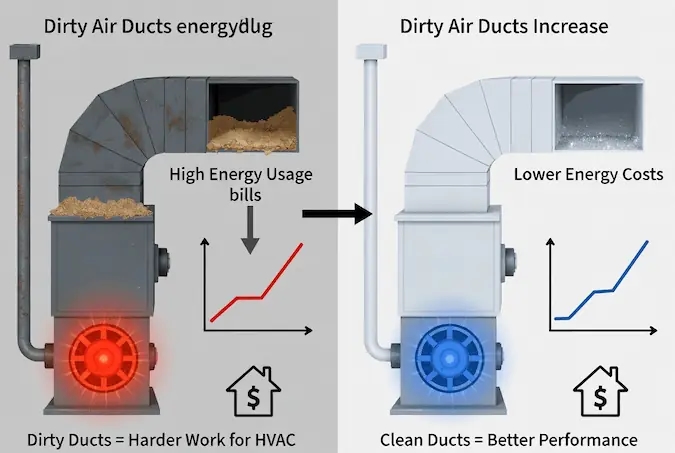
In a single-family house a dryer vent runs six to twelve feet through a wall. In a Reston Town Center condo or a Wiehle-area stacked townhome the exhaust riser can climb three stories through an interior chase. Lint accumulates at every elbow and change of direction. The riser also traps warm, moist air. On a July evening when outdoor humidity is already above 70 percent, that moisture migrates through the chase wall into the same cavity that holds the nearest supply trunk.
The result is a two-part problem that neither a new filter nor a dehumidifier fully addresses: particulate from the corridor loads the supply side while lint-driven moisture feeds the conditions that make dust stick. Homeowners notice it as a film that returns within days of wiping registers — especially on the side of the unit closest to the parking court.
Our Special Offers
Transparent flat-rate pricing. No counting vents. No surprise add-ons.
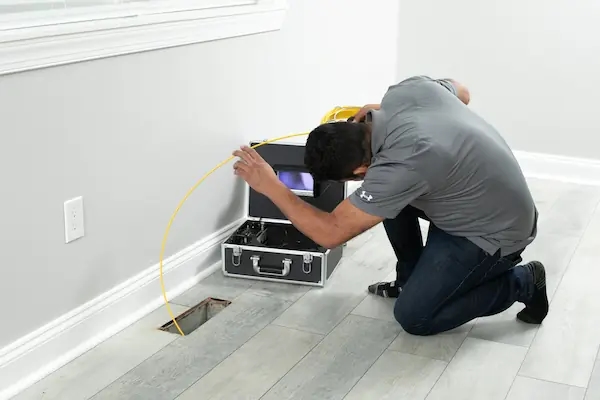
Dryer Vent Cleaning
$199
Professional dryer vent cleaning with rotary brush and high-powered vacuum to reduce fire risk and improve dryer efficiency.
Learn more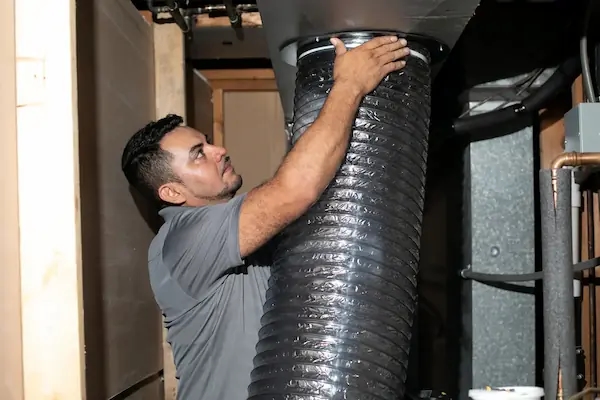
Air Duct Cleaning & Sanitization
$299
Professional cleaning of one complete air duct system with complimentary sanitization upon request and before/after photo proof.
Learn more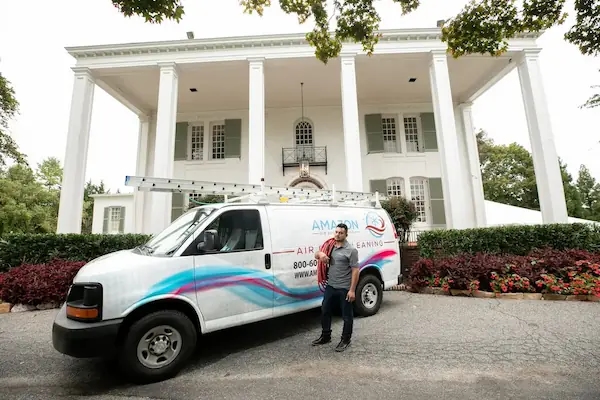
Air Duct Cleaning, Dryer Vent Cleaning & Sanitization
$399
Complete air duct system cleaning plus dryer vent cleaning and sanitization — our most popular package.
Learn moreBelow-grade parking garages and ground-floor returns
Town Center condos above retail typically draw return air from the lowest living level. That level often shares a slab or an air gap with a parking garage. Garage exhaust contains carbon monoxide, tire particulate, and whatever the garage ventilation system recirculates. Sealed floors reduce the transfer, but door seals degrade and concrete is porous. Over a few years the return side of the air handler accumulates a fine, oily residue that standard residential filters rate poorly against.
If you notice an oil-like sheen on the supply grille closest to the floor, the problem is usually below your unit, not above it. A standard surface wipe removes the visible film, but the inside of the trunk holds the same residue from every week you did not wipe.
Practical indicators that the ducts need attention
Not every dusty register means you need professional cleaning. These patterns, specific to Reston's corridor-and-village layout, tend to separate normal dust from a duct-level issue:
- Registers on the parking-court side gray out noticeably faster than registers on the path side of the same unit.
- The laundry closet stays warm between loads and the dryer consistently needs a second cycle to finish towels.
- A faint musty note appears on the first AC cycle after a rainy stretch, then fades — repeating weekly through July and August.
- Filter replacement every 30 days still leaves visible film on supplies near the floor.
Reducing the load between professional cleanings
Village-density living means you cannot control the air outside. You can control how much of it stays inside the trunks. For Reston-specific service options and scheduling, visit the Reston location page. Pair duct work with dryer vent cleaning if the riser serves stacked laundry — the two jobs share access points and are faster together.
- Run a standalone dehumidifier in lower-level units from June through September to keep indoor RH below 50 percent.
- Swap to a MERV-11 or MERV-13 filter if your air handler supports it — check the spec plate before upgrading, because over-restricting airflow can cause coil icing.
- Wipe return grilles monthly during pollen season; each wipe removes thousands of particles before they enter the trunk.
- Schedule dryer-riser cleaning annually if the riser serves more than one story.
Frequently Asked Questions
When should Reston homeowners consider duct cleaning?
When road and corridor dust around Reston leaves gray film on supplies faster than filter changes explain.
Where do I book air duct cleaning for Reston?
Open the Reston service page for flat-rate packages and local dispatch, or call (800) 606-3334 for Reston.
Can Reston duct and dryer vent cleaning happen the same day?
Yes — book ducts, dryer vents, or both in one visit for Reston from the Burke crew.
What proof should a Reston cleaning include?
Before-and-after photos of Reston trunks or vents, plus a flat-rate scope agreed before work starts.
Where we schedule from
For booking, use your city page or call our Burke and Bethesda offices. See all cities we serve.
Our offices
Contact Us
Our specialists will contact you immediately. (800) 606-3334 · support@amazonadc.com