Blog
1970s Stedwick closets, Whetstone paths, and why Lakeforest-era vents were never resized
Montgomery Village is a 1970s planned community where original dryer runs and undersized vents are still in service. Here's how aging infrastructure and lakeside humidity affect duct air quality.

Fifty-year-old vent paths still serving modern appliances
When Kettler Brothers built Montgomery Village starting in the late 1960s, the standard residential dryer was a compact top-loader that exhausted through a short, straight vent. The furnace was a standing-pilot unit half the size of a modern air handler. Duct runs were calculated for that era's airflow needs. Today those same pathways carry output from high-capacity dryers and variable-speed blowers — equipment that pushes more air, more lint, and more moisture through passages that were never widened.
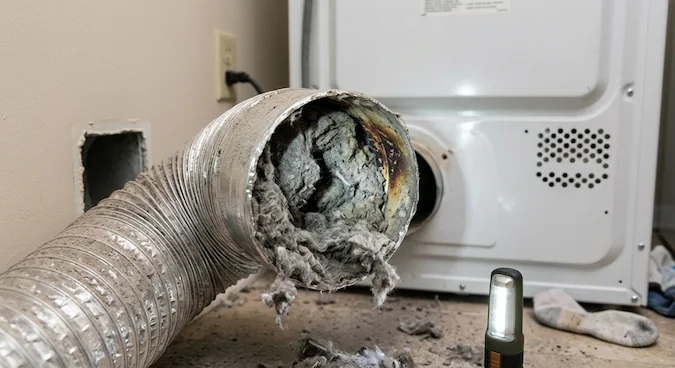
The mismatch is invisible from the living room. Inside the walls, lint accumulates at bends that were tight for 1972 and are tighter for 2024. Moisture that should exit the building in seconds lingers in the run, raising the humidity inside the mechanical closet and, by extension, the trunk lines inches away.
Lakeside micro-climate and what it means for lower-level trunks
Montgomery Village's lakes — South Valley Park, the Whetstone retention ponds, and the greenway channels through Stedwick — are shallow and warm from May through September. On calm evenings the water surface radiates moisture that collects in the lowest points of nearby neighborhoods. A townhome on Stedwick Road with a walkout lower level sits in that micro-climate pocket for hours each night.
The air handler in the lower level draws that humid air across a cold evaporator coil and pushes it into supply trunks that run through the ceiling above. Those trunks cool further as they extend toward upstairs registers. The temperature drop causes condensation, and any particulate matter already in the airstream — leaf fragments from the pathways, grass dust from the HOA's weekly mowing, general suburban pollen — adheres to the wet metal.
Our Special Offers
Transparent flat-rate pricing. No counting vents. No surprise add-ons.
Dryer Vent Cleaning
$199
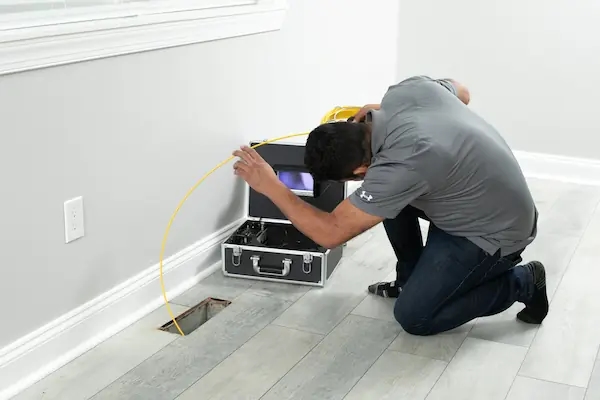
Professional dryer vent cleaning with rotary brush and high-powered vacuum to reduce fire risk and improve dryer efficiency.
Learn more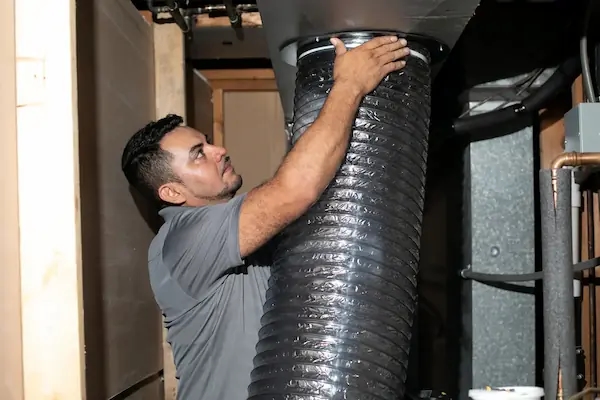
Air Duct Cleaning & Sanitization
$299
Professional cleaning of one complete air duct system with complimentary sanitization upon request and before/after photo proof.
Learn more
Air Duct Cleaning, Dryer Vent Cleaning & Sanitization
$399
Complete air duct system cleaning plus dryer vent cleaning and sanitization — our most popular package.
Learn moreWeekly HOA maintenance creates a recurring pollen and debris cycle
The homeowner association maintains common areas on a strict schedule. Mowing crews cut paths and medians, blowing clippings and stirring pollen that settled overnight. Leaf-blowing in autumn sends a cloud of organic debris across parking areas and against townhome walls. All of this happens within feet of exterior return intakes and dryer exhaust caps.
A house with sealed windows and a clean filter handles this reasonably well for a season. Over several years, though, the cumulative load on return ductwork adds up. Fine particles that pass through a standard MERV-8 filter deposit on trunk walls where airflow is slowest — typically at bends and branch take-offs. Those deposits grow each season and eventually restrict airflow enough to change how the system performs.
Common signals in a Montgomery Village townhome
Because the housing stock is uniform, the warning signs tend to appear in a predictable order across the community:
- A musty or stale smell from lower-level registers that strengthens during humid weeks and eases in winter.
- A visible film — often greenish during spring, gray in autumn — on supply grilles in upstairs bedrooms.
- Dryer cycles that stretch past the expected time, especially in summer when the vent run is already warm.
Resetting a system that has been accumulating for decades
A single cleaning appointment removes the accumulated film and debris that filters could not prevent. After that reset, the same filters work far more effectively because they are managing only new intake rather than recirculating embedded material. Running a dehumidifier in the lower level from late spring through early fall further slows the condensation cycle.
Flat-rate packages and scheduling for Montgomery Village are on the Montgomery Village, MD service page. If the dryer closet has a warm or humid feel after a load finishes, add dryer vent cleaning — the original vent routing in most village townhomes has at least one sharp bend that traps lint out of sight.
Frequently Asked Questions
When should Montgomery Village homeowners consider duct cleaning?
When dust returns quickly, airflow feels weak, or dry times climb in Montgomery Village homes.
Where do I book air duct cleaning for Montgomery Village?
Open the Montgomery Village service page for flat-rate packages and local dispatch, or call (800) 606-3334 for Montgomery Village.
Can Montgomery Village duct and dryer vent cleaning happen the same day?
Yes — book ducts, dryer vents, or both in one visit for Montgomery Village from the Bethesda crew.
What proof should a Montgomery Village cleaning include?
Before-and-after photos of Montgomery Village trunks or vents, plus a flat-rate scope agreed before work starts.
Where we schedule from
For booking, use your city page or call our Burke and Bethesda offices. See all cities we serve.
Our offices
Contact Us
Our specialists will contact you immediately. (800) 606-3334 · support@amazonadc.com