Blog
Laurel Hill HOAs, Lorton Station stacks, and why river air plus interstate grit stick
Lorton sits at the intersection of two particle sources: I-95 traffic dust and Occoquan River humidity. Discover how these combine inside both new-build townhome ducts and older Lorton Road split-levels — and why river-humid air makes interstate grit bond to cool trunk surfaces.

Where an interstate and a river corridor overlap
Most communities deal with either traffic dust or river humidity. Lorton gets both. I-95 runs along the western edge, generating a continuous stream of brake particles, tire-wear rubber, and diesel soot. The Occoquan River and its tributaries run along the southern and eastern edges, adding a moisture mass that keeps local dew points 3–5 degrees higher than locations a few miles inland. Where those two influences overlap — and they overlap across virtually all of Lorton's residential zones — the combination is uniquely effective at loading ductwork.
Humidity alone does not damage ducts. Traffic dust alone creates a dry, loose film that partially shakes free with normal airflow. But humidity bonded to traffic particulate creates a sticky composite on cold metal surfaces that grows denser with each AC season and does not re-suspend. It accumulates. That is why Lorton trunk interiors tend to show a hard, dark coating rather than the loose dust common in drier suburban environments.
New and old housing, same duct problem, different geometry
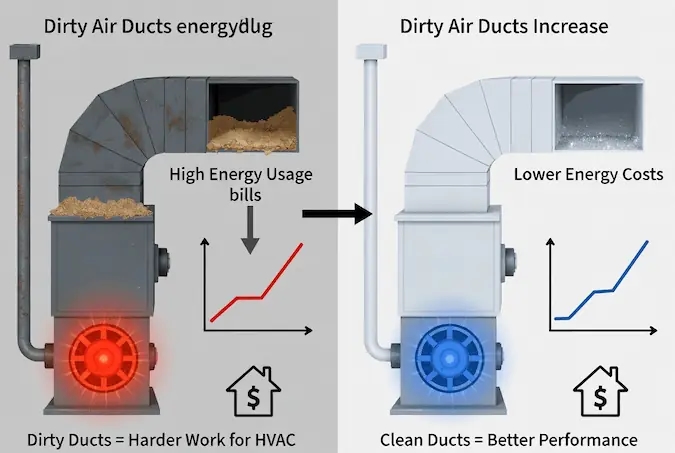
Lorton Station and Laurel Hill are 2000s–2010s construction: townhomes with stacked laundry, interior mechanical closets, and compact duct runs through conditioned space. Older Lorton Road and Gunston-area houses are 1970s split-levels with air handlers in daylight basements and long trunk runs through unconditioned crawl spaces. The Lorton Station systems accumulate corridor dust in their short, tight runs because the returns sit at street level in dense clusters. The older split-levels accumulate it in long, cold trunk runs where river humidity provides the bonding moisture.
Despite the different geometries, both housing types tend to show the same symptom: a register that grays out within a few days of wiping. In the townhome, the gray comes from short proximity to the dust source. In the split-level, it comes from deep accumulation in the trunk releasing incrementally with each blower cycle.
Our Special Offers
Transparent flat-rate pricing. No counting vents. No surprise add-ons.
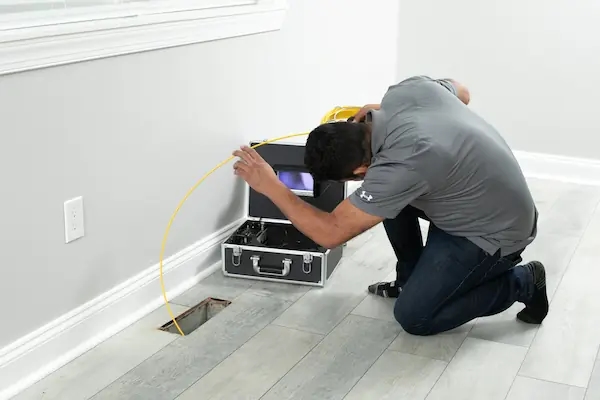
Dryer Vent Cleaning
$199
Professional dryer vent cleaning with rotary brush and high-powered vacuum to reduce fire risk and improve dryer efficiency.
Learn more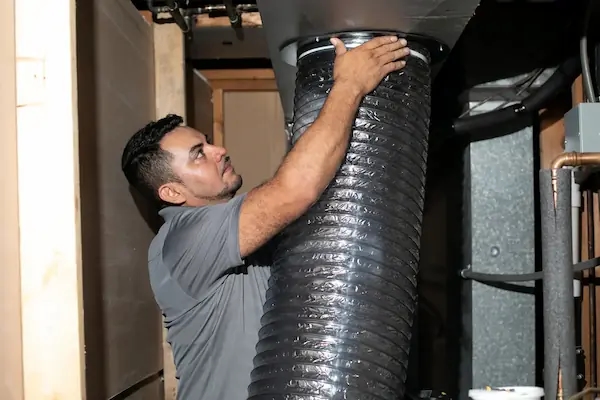
Air Duct Cleaning & Sanitization
$299
Professional cleaning of one complete air duct system with complimentary sanitization upon request and before/after photo proof.
Learn more
Air Duct Cleaning, Dryer Vent Cleaning & Sanitization
$399
Complete air duct system cleaning plus dryer vent cleaning and sanitization — our most popular package.
Learn moreThe VRE corridor adds vibration that shakes dust loose
Lorton Station is named for its proximity to the VRE commuter rail. Homes within a few hundred feet of the rail line experience low-frequency vibration during morning and evening train passages. That vibration is below human perception in most rooms, but it is enough to dislodge settled particles inside ductwork. Homeowners near the tracks sometimes notice a small puff of dust from a supply register at roughly the same time each morning — that is settled trunk dust re-suspending from train vibration, then carried out by the next blower cycle.
The effect is subtle but cumulative. Homes on the rail side of Lorton Station streets tend to have slightly cleaner trunk interiors (because dust keeps getting ejected) but dustier living spaces (because that dust lands on furniture). A home a block farther from the tracks retains more dust inside the trunks and shows it less visibly in the rooms — until a cleaning removes it all at once.
Patterns that distinguish Lorton's dual-source problem
Standard dust accumulation happens everywhere. These signs are characteristic of the interstate-plus-river combination:
- A hard, dark film inside the trunk that does not wipe off easily with a dry cloth — it requires a damp wipe or scrubbing, unlike loose household dust.
- Registers on the I-95 side of the house accumulate gray film two to three times faster than registers on the opposite side.
- Musty smell specifically during the first AC cycle after a humid night or rainy stretch — this indicates moisture-bonded biological material inside the trunk, fed by Occoquan-corridor humidity.
- A split-level lower level that smells stale even with the windows open, because the air handler is recirculating trunk-stored particulate from years of accumulation.
Working with the dual-source environment
You cannot relocate the interstate or the river. You can manage how their combined particulate behaves inside your system. For Lorton service details and flat-rate options, visit the Lorton location page. If the townhome dryer chase runs to a roof cap, dryer vent cleaning is efficient to combine with duct work since the crew is already accessing the chase.
- Use a MERV-11 or higher filter if the air handler supports it — the finer capture rate matters more in a high-particulate zone than in a low-traffic suburb.
- Dehumidify the lower level of split-levels to 45–50 percent RH from May through October to slow the moisture-bonding cycle.
- After cleaning, photograph the inside of one trunk at the supply register. Compare it six months later. If the dark film is returning fast, shorten the cleaning interval from the typical 1–3 years.
- Clear stacked dryer vents annually; the compressed-lint risk accelerates in a humid environment.
Frequently Asked Questions
When should Lorton homeowners consider duct cleaning?
When road and corridor dust around Lorton leaves gray film on supplies faster than filter changes explain.
Where do I book air duct cleaning for Lorton?
Open the Lorton service page for flat-rate packages and local dispatch, or call (800) 606-3334 for Lorton.
Can Lorton duct and dryer vent cleaning happen the same day?
Yes — book ducts, dryer vents, or both in one visit for Lorton from the Burke crew.
What proof should a Lorton cleaning include?
Before-and-after photos of Lorton trunks or vents, plus a flat-rate scope agreed before work starts.
Where we schedule from
For booking, use your city page or call our Burke and Bethesda offices. See all cities we serve.
Our offices
Contact Us
Our specialists will contact you immediately. (800) 606-3334 · support@amazonadc.com