Blog
Antique Row weekends, Howard Avenue brick, and why basement trunks sweat in close-in Montgomery
Kensington's colonials sit where Connecticut Avenue's street-tree pollen meets weekend foot traffic from Antique Row. Learn how the basement air handler in a close-in Montgomery County colonial stores spring pollen in cold trunks — and why the problem compounds each year without intervention.

Connecticut Avenue works as a pollen delivery channel
Street trees along Connecticut Avenue — planted in a nearly unbroken line from the DC border through Chevy Chase and into Kensington — create a linear canopy that channels pollen along the road corridor. When wind blows from the south during April and May, pollen from the DC-Chevy Chase section of the avenue migrates north along the tree line and adds to the local Kensington canopy's output. The combined load is heavier than either zone would produce alone.
Homes on Connecticut Avenue and the blocks immediately east and west of it sit directly in this channel. Returns on the front of the house — typically facing the street — intercept the highest concentration. By contrast, a house a half-mile off the avenue on a quieter dead-end street may receive only its own lot's pollen production, which can be significantly less.
The colonial basement air handler is both the engine and the reservoir
In a Kensington colonial, the air handler sits in the unfinished or semi-finished basement. Supply trunks extend from the plenum through the joist bays above. The air handler pulls return air from the upper floors, filters it, conditions it, and pushes it back up through the supply trunks. The return path and the supply path both pass through the basement — the coolest, most humid room in the house.
During summer cooling, the air handler's evaporator coil removes moisture from the return air. But the trunk surfaces downstream of the coil remain at or near coil temperature for several feet. This cold zone is where condensation is heaviest and where incoming pollen bonds most effectively. The air handler is simultaneously solving one moisture problem (dehumidifying the return air) and creating another (condensing moisture onto the supply trunks in its own vicinity).
Our Special Offers
Transparent flat-rate pricing. No counting vents. No surprise add-ons.
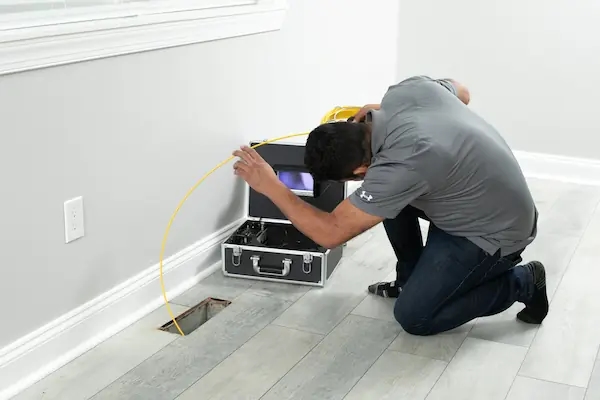
Dryer Vent Cleaning
$199
Professional dryer vent cleaning with rotary brush and high-powered vacuum to reduce fire risk and improve dryer efficiency.
Learn more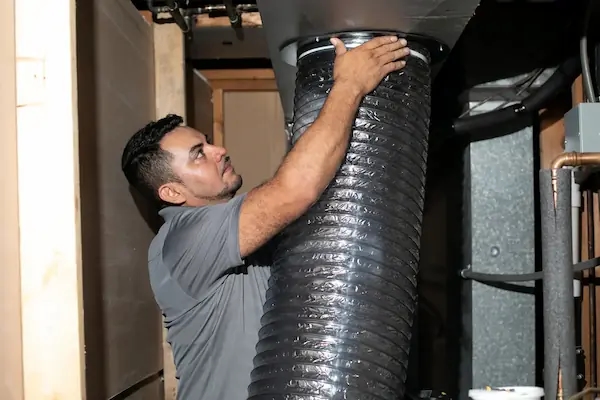
Air Duct Cleaning & Sanitization
$299
Professional cleaning of one complete air duct system with complimentary sanitization upon request and before/after photo proof.
Learn more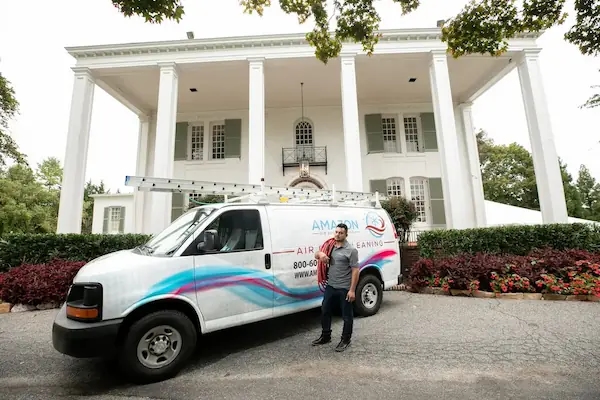
Air Duct Cleaning, Dryer Vent Cleaning & Sanitization
$399
Complete air duct system cleaning plus dryer vent cleaning and sanitization — our most popular package.
Learn moreWeekend foot traffic adds a particle type you would not expect
Antique Row along Howard Avenue draws visitors on weekends who park on residential side streets. The increase in low-speed vehicle traffic, car doors opening and closing, and foot traffic on gravel and aged sidewalks kicks up a fine mineral dust that is distinct from the organic pollen from the tree canopy. This mineral fraction is heavier than pollen and settles quickly — into window wells, onto stoops, and into ground-level return grilles.
The weekend-traffic dust is minor compared to the pollen load in absolute volume, but it has a different effect inside the trunk. Mineral particles are harder and more abrasive than pollen grains. When they mix with the condensation layer on trunk walls, they create a rougher surface texture that captures subsequent pollen even more efficiently. The combination is self-reinforcing: each layer of mineral dust makes the next pollen season's accumulation stick better.
Why the problem compounds rather than stabilizing
In a low-humidity, low-particulate environment, duct accumulation eventually reaches a rough equilibrium: the rate of deposition matches the rate at which airflow dislodges settled particles. In Kensington's environment — high seasonal pollen, chronic basement humidity, and supplemental mineral dust — the deposition rate consistently exceeds the dislodging rate. The buildup compounds each year. This means a duct system that was acceptably clean at year three may be noticeably problematic by year five and significantly loaded by year seven.
Homeowners who have never seen the inside of their trunk often assume that because the house has not changed, the duct condition has not changed either. In a compounding environment like Kensington's, the opposite is true. Each year adds a measurable increment that does not self-correct.
Slowing the compounding cycle
The Kensington compounding pattern responds best to a combination of professional cleaning and between-service moisture control. For Kensington scheduling and pricing, visit the Kensington location page. If you want to understand the trunk-cleaning process before committing, the air duct cleaning overview covers what a service appointment includes.
- Dehumidify the basement to 48 percent RH or below from April through October — breaking the condensation cycle is the single most effective way to slow the compounding rate.
- Replace filters at the beginning of pollen season (late March) and again at the midpoint (late April) rather than on a fixed 90-day calendar.
- Wipe return grilles on the Connecticut Avenue side of the house biweekly during pollen season — each wipe removes thousands of grains before they enter the trunk.
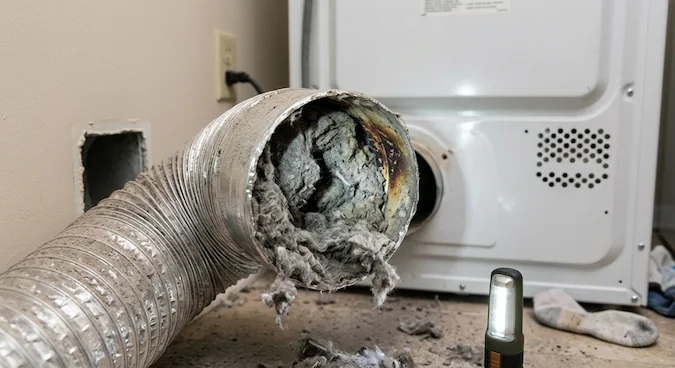
- If the house has a second-floor laundry with a drop to a rear-wall cap, schedule dryer vent cleaning annually to prevent lint from adding to the basement moisture load.
Frequently Asked Questions
When should Kensington homeowners consider duct cleaning?
When musty startup smells return each humid week, or cool Kensington trunks keep turning dust into a sticky film.
Where do I book air duct cleaning for Kensington?
Open the Kensington service page for flat-rate packages and local dispatch, or call (800) 606-3334 for Kensington.
Can Kensington duct and dryer vent cleaning happen the same day?
Yes — book ducts, dryer vents, or both in one visit for Kensington from the Bethesda crew.
Does a dehumidifier replace duct cleaning in Kensington?
Lower humidity helps Kensington basements, but it does not remove debris already sitting in trunks. Cleaning and moisture control work together.
Where we schedule from
For booking, use your city page or call our Burke and Bethesda offices. See all cities we serve.
Our offices
Contact Us
Our specialists will contact you immediately. (800) 606-3334 · support@amazonadc.com