Blog
Georgetown Pike lots, long dryer runs, and why walk-out basements sweat at the trunks
Great Falls homes on large wooded lots run HVAC ductwork 40–60 feet through crawls and walk-out basements. Find out how estate-scale trunk systems, long dryer runs, and Potomac River humidity interact — and why bigger houses have harder-to-reach problems.

Why bigger houses hide bigger duct problems
A 4,000-square-foot house on Georgetown Pike or Walker Road may have 200 linear feet of ductwork when you add up every supply branch, return trunk, and connection. Many of these homes were built in stages — an original wing, a later addition over the garage, a guest suite, a screened porch converted to conditioned space. Each phase brought its own HVAC branch grafted onto the original system. The splices between eras are where dust collects most aggressively because fitting tolerances and sealant styles changed with each decade.
From the living room everything looks fine. The problem is twenty feet into a trunk run that travels through a walk-out basement soffit or along a crawl-space joist bay that nobody enters. Out of sight, dust and moisture have been layering quietly since the last addition went up.
The Potomac adds humidity you cannot feel on the patio
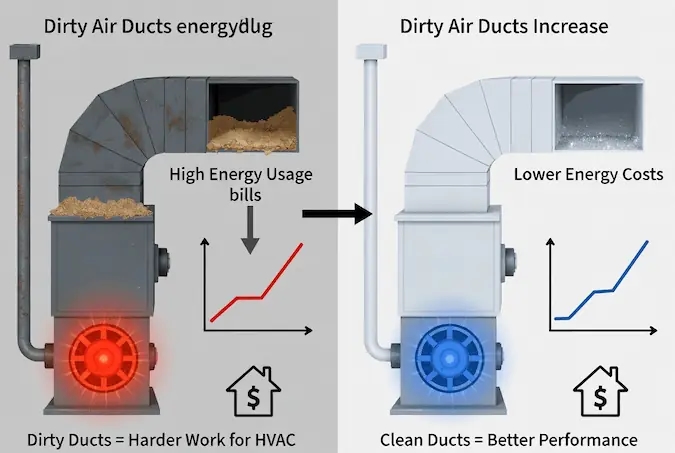
Great Falls lots sit close enough to the Potomac that the river's evaporative mass influences local dew points even on days when the breeze feels pleasant. A walk-out basement with the door closed on a July afternoon can register 70 percent relative humidity while the thermometer reads only 72 degrees. At that combination the dew point on a 55-degree supply trunk is well above the surface temperature of the metal, so condensation forms continuously while the system runs.
Homes with well and septic systems — still common on larger Great Falls lots — add another moisture source: ground moisture migrating through the slab or crawl-space floor. This is low-grade, constant, and invisible until you see its effect on the trunk surfaces.
Our Special Offers
Transparent flat-rate pricing. No counting vents. No surprise add-ons.
Dryer Vent Cleaning
$199
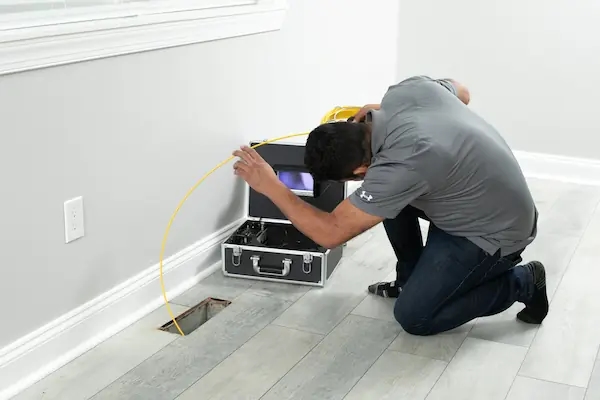
Professional dryer vent cleaning with rotary brush and high-powered vacuum to reduce fire risk and improve dryer efficiency.
Learn more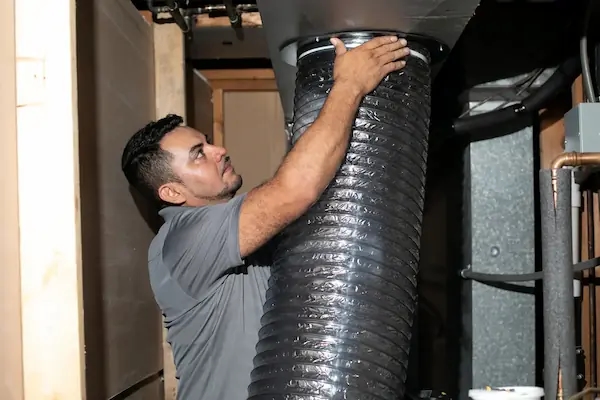
Air Duct Cleaning & Sanitization
$299
Professional cleaning of one complete air duct system with complimentary sanitization upon request and before/after photo proof.
Learn more
Air Duct Cleaning, Dryer Vent Cleaning & Sanitization
$399
Complete air duct system cleaning plus dryer vent cleaning and sanitization — our most popular package.
Learn moreFifty-foot dryer runs change the maintenance math
In a compact house a dryer vent cleaning is a short job with good access. On a Great Falls property the laundry may sit in an interior room and the vent may travel 40 to 60 feet through a finished lower level, make two or three direction changes, and exit at a cap hidden behind landscaping. Every elbow adds lint accumulation and reduces exhaust velocity. When lint restricts the cap, moisture backs up through the entire run and raises humidity in the wall cavity adjacent to the nearest supply duct.
Long dryer runs also increase fire risk. The National Fire Protection Association identifies failure to clean as the leading factor in residential dryer fires. At 50 feet of run, the margin for neglect is thinner than in a ranch-style home where the vent is six feet long.
What to look for on a large-lot property
Estate homes present symptoms differently than townhomes or ramblers. Look for these patterns specific to large-lot, multi-wing Great Falls houses:
- Different dust levels between the original wing and the addition — this usually indicates a leaking splice where the two systems were joined.
- A musty note in the walk-out level that disappears once you open the slider, then returns within an hour of closing it.
- Towels that are slightly damp after a full dryer cycle, especially during humid months — a sign of restricted exhaust on a long run.
- Supply registers in a guest wing or bonus room that blow noticeably less air than registers near the main air handler.
Access and logistics on large Great Falls properties
Cleaning estate-scale ductwork takes more time and different equipment than a townhome job. Access points may be in finished soffits, behind cabinetry, or in crawl spaces that require specific clearance. For Great Falls service details and flat-rate packages that account for square footage, visit the Great Falls location page. Long dryer runs should be paired with dryer vent cleaning — the crew is already on-site and the vent access overlaps.
- Walk the exterior and confirm the dryer cap location before scheduling — some caps are concealed by landscape growth and need trimming for access.
- If the home has multiple HVAC zones, note which zone produces the musty smell so the crew can prioritize that trunk.
- Dehumidify the walk-out level to 45–50 percent RH through the summer — this slows new condensation on trunks between cleanings.
Frequently Asked Questions
When should Great Falls homeowners consider duct cleaning?
When musty startup smells return each humid week, or cool Great Falls trunks keep turning dust into a sticky film.
Where do I book air duct cleaning for Great Falls?
Open the Great Falls service page for flat-rate packages and local dispatch, or call (800) 606-3334 for Great Falls.
Can Great Falls duct and dryer vent cleaning happen the same day?
Yes — book ducts, dryer vents, or both in one visit for Great Falls from the Burke crew.
Does a dehumidifier replace duct cleaning in Great Falls?
Lower humidity helps Great Falls basements, but it does not remove debris already sitting in trunks. Cleaning and moisture control work together.
Where we schedule from
For booking, use your city page or call our Burke and Bethesda offices. See all cities we serve.
Our offices
Contact Us
Our specialists will contact you immediately. (800) 606-3334 · support@amazonadc.com