Blog
I-270 humidity, cool trunks, and why Crown dryer vents pack with lint
Gaithersburg's housing ranges from 1960s split-levels to Kentlands new urbanism. Each style has its own duct failure pattern — here's how they work and when cleaning helps.

Three housing eras, three different duct problems
Gaithersburg's housing stock spans an unusually wide range. The original neighborhoods around City Hall include 1950s and 1960s split-levels and ramblers with basement air handlers. Kentlands and Lakelands brought new-urbanist townhomes and singles in the 1990s with compact mechanical closets. Crown and the Rio corridor added high-density condos and apartments in the 2000s with stacked laundry and shared-chase dryer vents.
Each housing era produces duct contamination through a different mechanism. Understanding which one applies to your home helps predict what a technician will find inside the system and how to prevent it from recurring.
1960s split-levels: the basement condensation trap

A Gaithersburg split-level has the air handler in a utility room that sits partially below grade. The concrete block walls are cool and, during Maryland summers, damp. Supply trunks running along the basement ceiling chill when the compressor engages, and the temperature differential between the cold metal and the warm, humid basement air produces condensation on the exterior surface of the trunk.
Inside the trunk the same process occurs in reverse — humid return air loses moisture to the cold duct walls. The resulting film catches every particle the filter missed: pollen that slipped past during the spring peak, skin cells, fabric fibers, and fine particulates from the I-270 corridor that entered through window seals and door gaps. Over years, the buildup becomes a thick, dark layer that reduces the duct's effective cross-section and supports biological growth in the absence of light.
Our Special Offers
Transparent flat-rate pricing. No counting vents. No surprise add-ons.
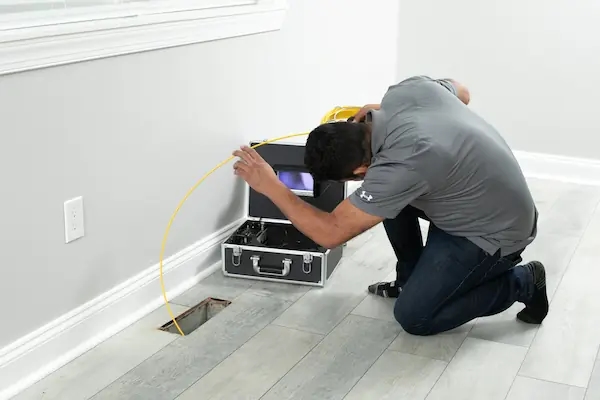
Dryer Vent Cleaning
$199
Professional dryer vent cleaning with rotary brush and high-powered vacuum to reduce fire risk and improve dryer efficiency.
Learn more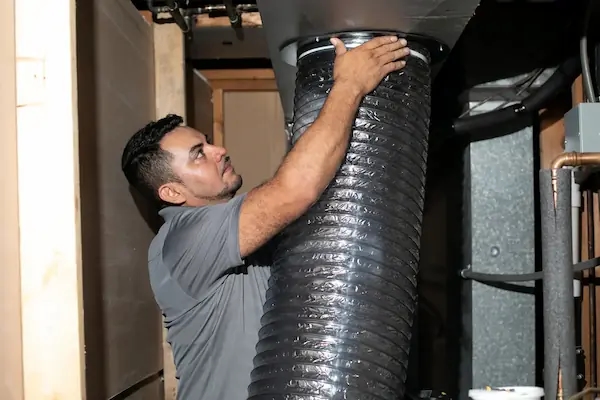
Air Duct Cleaning & Sanitization
$299
Professional cleaning of one complete air duct system with complimentary sanitization upon request and before/after photo proof.
Learn more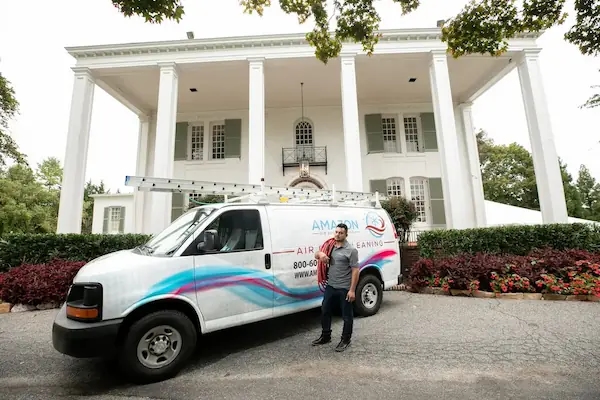
Air Duct Cleaning, Dryer Vent Cleaning & Sanitization
$399
Complete air duct system cleaning plus dryer vent cleaning and sanitization — our most popular package.
Learn moreKentlands and Lakelands: compact design, compact duct problems
New-urbanist townhomes prioritize walkability and architectural variety over generous mechanical spaces. The furnace and air handler in a typical Kentlands row unit fit into a first-floor closet or alcove. Duct runs are short, which is an advantage for airflow efficiency, but the tight space means the dryer vent, gas line, and electrical panel all compete for room.
The dryer vent in these homes typically makes two or three bends before reaching the exterior cap. Each bend is a lint accumulation point. When the vent partially clogs, exhaust air and moisture back up into the laundry closet, raising the humidity in the mechanical area. That moisture enters the adjacent HVAC ductwork through shared framing cavities. A Kentlands owner who notices the laundry closet feels warm and damp after a dryer cycle is likely experiencing the early stage of this chain.
Matching Gaithersburg symptoms to housing type
The most effective diagnostic shortcut is to consider what decade your home was built and what type of mechanical space it has:
- Split-level or rambler (1950s–1970s): musty odor from basement registers during humid weeks, dark residue at register edges, and a dehumidifier that fills its reservoir faster than the manufacturer suggests.
- Kentlands or Lakelands townhome (1990s–2000s): dryer cycles running long, a warm or humid laundry closet, and a faint lint smell near interior walls adjacent to the dryer.
- Crown or Rio corridor condo (2000s–present): building-wide stuffiness during peak summer, a sense that the AC runs constantly without fully dehumidifying, and visible dust accumulation near ceiling-mounted supply diffusers.
Choosing the right maintenance for your Gaithersburg home
Split-level owners benefit most from duct cleaning combined with a dehumidifier installation or optimization in the basement. Townhome owners benefit from paired duct and dryer vent cleaning, since the two systems are physically adjacent and each contributes moisture to the other. Condo residents should coordinate with building management on shared-chase dryer vent cleaning while addressing their individual unit's duct system.
Flat-rate packages and scheduling for all Gaithersburg housing types are on the Gaithersburg, MD service page. Add dryer vent cleaning to any duct appointment if the laundry area retains warmth or humidity after a cycle — the two services together address the shared-space moisture loop that drives most Gaithersburg duct contamination.
Frequently Asked Questions
When should Gaithersburg homeowners consider duct cleaning?
After nearby build-out or renovations that put fines in returns — or when Gaithersburg registers refilm within days of wiping.
Where do I book air duct cleaning for Gaithersburg?
Open the Gaithersburg service page for flat-rate packages and local dispatch, or call (800) 606-3334 for Gaithersburg.
Can Gaithersburg duct and dryer vent cleaning happen the same day?
Yes — book ducts, dryer vents, or both in one visit for Gaithersburg from the Bethesda crew.
Should I wait until construction near Gaithersburg finishes?
Heavy drywall dust near Gaithersburg often shortens the useful interval. Wait until the worst dust settles, then inspect returns before booking.
Where we schedule from
For booking, use your city page or call our Burke and Bethesda offices. See all cities we serve.
Our offices
Contact Us
Our specialists will contact you immediately. (800) 606-3334 · support@amazonadc.com