Blog
Cool basements, oak pollen, and why City of Fairfax registers get dusty again
The City of Fairfax packs a dense canopy into a small footprint. Learn how mid-century ramblers and later additions create duct junctions where pollen and condensation accumulate.

A small city with a big-forest pollen load
The independent City of Fairfax covers roughly six square miles. Within that compact area, mature oaks, maples, and tulip poplars form an overhead canopy that rivals any park in the region. During April and May the pollen output per acre is staggering — visible as a yellow film on every horizontal surface within hours of a dry, breezy morning.
Residential HVAC systems respond to outdoor air quality even when windows are closed. Return grilles near exterior doors, garage entries, and dryer exhaust caps allow pollen to enter the duct system. Once inside, the particles travel to the coolest surfaces available — typically the supply trunks that run through or above the basement ceiling — and stick.
How 1950s–1980s rambler architecture creates specific duct failures
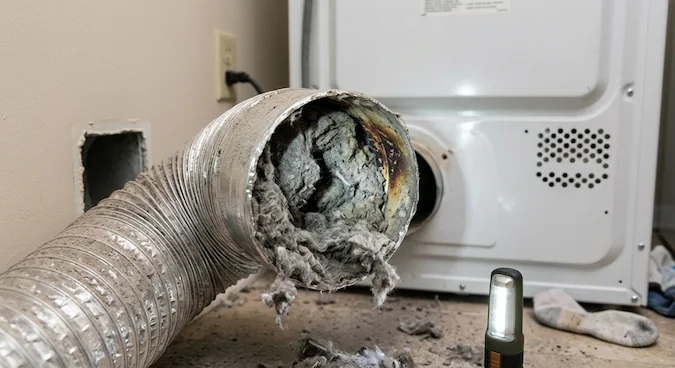
The City of Fairfax grew primarily during the postwar suburban boom. Ramblers, split-levels, and raised ranches from that era share a design trait: the furnace and air handler sit in a full or partial basement, and the trunk line runs along the basement ceiling to reach registers on the main floor. That path is short, direct, and cool — three qualities that promote condensation when humid July air enters the system.
The problem compounds in homes that received additions in the 1980s or 1990s. Adding a family room or an expanded kitchen typically meant splicing a new duct branch onto the existing trunk. The splice point — a sheet-metal takeoff fastened with screws and sealed with tape or mastic — creates a ledge inside the airstream where debris accumulates. Over decades, these junctions become the dirtiest sections of the system, and they are invisible without removing a register cover and looking inside with a light.
Our Special Offers
Transparent flat-rate pricing. No counting vents. No surprise add-ons.
Dryer Vent Cleaning
$199
Professional dryer vent cleaning with rotary brush and high-powered vacuum to reduce fire risk and improve dryer efficiency.
Learn more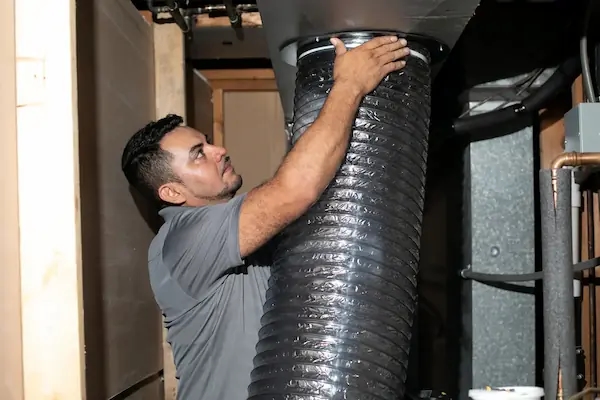
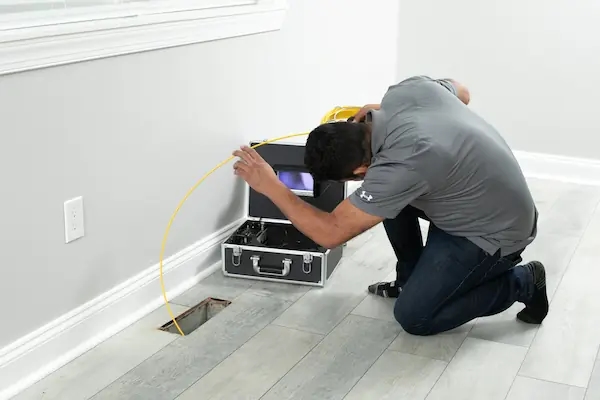
Air Duct Cleaning & Sanitization
$299
Professional cleaning of one complete air duct system with complimentary sanitization upon request and before/after photo proof.
Learn more
Air Duct Cleaning, Dryer Vent Cleaning & Sanitization
$399
Complete air duct system cleaning plus dryer vent cleaning and sanitization — our most popular package.
Learn moreThe condensation cycle that makes dust permanent
Pollen and household dust are dry particles that, in theory, could be dislodged by airflow alone. In practice, the condensation cycle in a basement-cooled duct system glues them in place. Here is the sequence: the AC cools the trunk metal below the dew point of the surrounding basement air. Moisture forms on the interior wall. Airborne particles land on the wet surface and bond. The system shuts off, the moisture evaporates, and the particles remain stuck to the metal like paint on a wall.
Repeat this cycle twice a day from June through September and the interior surface develops a layered coating. Each spring's pollen season adds a new stratum on top of the previous year's deposit. A filter change intercepts new intake but does nothing about the layers already downstream.
Signals that a City of Fairfax system is overdue
Rambler owners often attribute recurring dust to the house being old. The house is fine. The duct system has accumulated material that filters were never designed to remove retroactively. Watch for these indicators:
- Gray or yellowish film on register faces that returns within a week of wiping, concentrated on upper-floor supply vents.
- A faint musty smell from basement registers that appears only when the AC cycles on and off, not during continuous run.
- Uneven airflow between original rooms and added spaces, suggesting debris has partially blocked a branch or takeoff.
Breaking the accumulation cycle
Professional cleaning removes the layered buildup that condensation bonded to the trunk walls. Once cleared, maintaining basement humidity below fifty percent with a dehumidifier and replacing filters on a pollen-season schedule rather than a fixed calendar keeps the system cleaner between appointments.
Flat-rate options and scheduling for City of Fairfax homes are on the Fairfax, VA service page. If the laundry closet or utility room stays warm after a dryer cycle, pair the duct work with dryer vent cleaning — Fairfax Corner townhomes in particular tend to have multi-bend dryer exhaust paths that trap lint.
Frequently Asked Questions
When should Fairfax homeowners consider duct cleaning?
When musty startup smells return each humid week, or cool Fairfax trunks keep turning dust into a sticky film.
Where do I book air duct cleaning for Fairfax?
Open the Fairfax service page for flat-rate packages and local dispatch, or call (800) 606-3334 for Fairfax.
Can Fairfax duct and dryer vent cleaning happen the same day?
Yes — book ducts, dryer vents, or both in one visit for Fairfax from the Burke crew.
Does a dehumidifier replace duct cleaning in Fairfax?
Lower humidity helps Fairfax basements, but it does not remove debris already sitting in trunks. Cleaning and moisture control work together.
Where we schedule from
For booking, use your city page or call our Burke and Bethesda offices. See all cities we serve.
Our offices
Contact Us
Our specialists will contact you immediately. (800) 606-3334 · support@amazonadc.com