Blog
What EPA, ENERGY STAR, and DOE actually say — and when cleaning still makes sense
· Updated
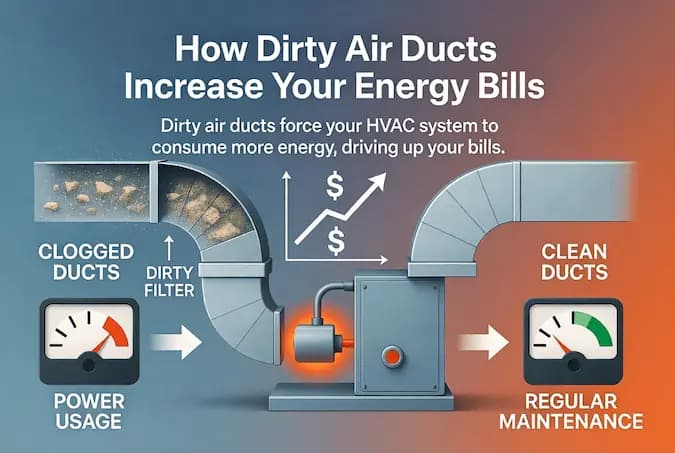
Do dirty air ducts raise energy bills? What EPA, ENERGY STAR, and DOE actually say — and when cleaning still helps.
Start with what federal guidance actually says

Heating and cooling use a large share of home energy. The U.S. Department of Energy treats them as major end uses — so anything that makes the system run longer is worth understanding.
EPA guidance on duct cleaning draws a clear line: some research suggests cleaning heating and cooling system components (cooling coils, fans, heat exchangers) may improve efficiency. EPA also states that little evidence exists that cleaning only the ducts will improve system efficiency. We follow that distinction when we talk about bills.
What can raise energy use in the air path
Several air-path issues are well established as efficiency problems — even when routine duct cleaning alone is not proven to cut bills:
- Clogged filters — restrict airflow; change them on schedule (EPA Indoor airPLUS filtration notes)
- Leaky ducts — ENERGY STAR notes that in a typical house about 20–30% of the air moving through the duct system can be lost to leaks, holes, and poor connections; sealing and insulating accessible ducts is a primary efficiency step
- Dirty coils / fans / heat exchangers — EPA notes cleaning these components may improve efficiency more than cleaning ducts alone
- Closed supply vents — can unbalance the system and force longer run times
Our Special Offers
Transparent flat-rate pricing. No counting vents. No surprise add-ons.

Dryer Vent Cleaning
$199
Professional dryer vent cleaning with rotary brush and high-powered vacuum to reduce fire risk and improve dryer efficiency.
Learn more
Air Duct Cleaning & Sanitization
$299
Professional cleaning of one complete air duct system with complimentary sanitization upon request and before/after photo proof.
Learn more
Air Duct & Dryer Vent Cleaning Combo
$399
Complete air duct system cleaning plus dryer vent cleaning — our most popular package. Optional antimicrobial on request.
Learn moreWhen debris in ducts may still matter
Heavy debris in ducts can narrow the effective path and contribute to uneven airflow room to room. An EPA field study of mechanical duct cleaning reported increased supply airflow in most study homes after cleaning — but the study did not establish a clear, meaningful reduction in energy use from duct cleaning alone.
Honest framing: cleaning can remove debris and may improve measured airflow in some systems. It is not a guaranteed utility-bill reduction, and EPA does not treat duct-only cleaning as a proven efficiency upgrade.
Coils and equipment — the stronger efficiency angle
Fine dust that reaches the evaporator coil, blower, or heat exchanger can interfere with heat transfer. That is closer to what EPA highlights when discussing possible efficiency benefits from cleaning HVAC components.
Annual HVAC maintenance that includes coil and blower inspection addresses those surfaces directly. Duct cleaning removes upstream debris that can recontaminate components over time — useful maintenance, not a promise of lower bills.
Sealing leaks vs cleaning dirt
Leaks in attic or crawlspace ducts waste conditioned air. ENERGY STAR's duct sealing guidance puts typical losses around 20–30% of the air moving through the system — and lists high bills, hard-to-condition rooms, and ducts in attics/crawlspaces/garages as common red flags. That is a clearer energy play than cleaning light dust from ducts.
During a cleaning visit we may notice disconnected joints or obvious gaps and flag them. Sealing is a separate step from mechanical debris removal — ask if you want both scoped.
Signs to investigate — without assuming ducts are the cause
These symptoms can have many causes (filters, refrigerant, sizing, leaks, thermostat). They are reasons to inspect, not proof that duct cleaning will cut your bill:
- Utility costs rising without a rate change or major usage shift
- HVAC running nearly continuously in mild weather
- Rooms that stay stuffy or never hit the set point
- Filters clogging far ahead of schedule
- Visible dust discharging from supplies
What we can honestly say cleaning does
Professional source-removal cleaning removes debris from duct surfaces and documents the work with before/after photos. In some homes, airflow at registers feels stronger afterward — consistent with EPA field observations of airflow gains in many study houses.
We do not claim a fixed percentage bill reduction from duct cleaning alone. For energy savings with stronger official backing, prioritize filter changes, duct sealing/insulation where ducts are leaky, and coil/equipment maintenance — then book duct cleaning when inspection shows substantial debris.
- Removes built-up debris from hard duct surfaces
- May improve measured or perceived airflow when ducts were restricted
- Supports cleaner coils longer when upstream dust was heavy
- Does not replace sealing leaky attic/crawlspace ducts
Habits that matter more month to month
These steps align with federal efficiency guidance more closely than routine duct cleaning:
- Change filters on schedule — a clogged filter is a fast way to choke airflow
- Use a filter MERV rating your blower can handle — higher is not always better on residential systems
- Keep supply registers open — closing vents often worsens balance
- Seal and insulate ducts in attics/crawlspaces when accessible (ENERGY STAR)
- Book HVAC tune-ups that include coil and blower inspection
Clear expectations — then book if the system is loaded
Dirty ducts can hold debris and affect airflow. Leaky ducts and dirty coils have clearer ties to wasted energy than light dust alone. EPA does not treat duct-only cleaning as a proven efficiency fix — and we will not sell you one.
If you want debris removed and documented — or inspection shows substantial buildup — call (800) 606-3334 or visit air duct cleaning. Combo packages with dryer vent cleaning are available. Find your city on locations.
Frequently Asked Questions
Can dirty ducts raise energy bills?
Restricted airflow can make equipment run longer. EPA says little evidence shows cleaning only the ducts improves efficiency; cleaning coils/fans/heat exchangers may help more. Cleaning is not a guaranteed bill cut.
What do official sources emphasize for duct energy losses?
ENERGY STAR highlights sealing leaky ducts (typical homes can lose about 20–30% of the air moving through the system to leaks). That is separate from cleaning dust inside ducts.
Will a filter change fix high bills?
Fresh filters help airflow. They do not remove debris already on trunks or coils, and they do not seal duct leaks.
How do I schedule service?
Call (800) 606-3334 for flat-rate residential packages from Burke, VA or Bethesda, MD — or open your city under Locations.
Where we schedule from
For booking, use your city page or call our Burke and Bethesda offices. See all cities we serve.
Our offices
Contact Us
Our specialists will contact you immediately. (800) 606-3334 · support@amazonadc.com